By Condé Nast Traveller
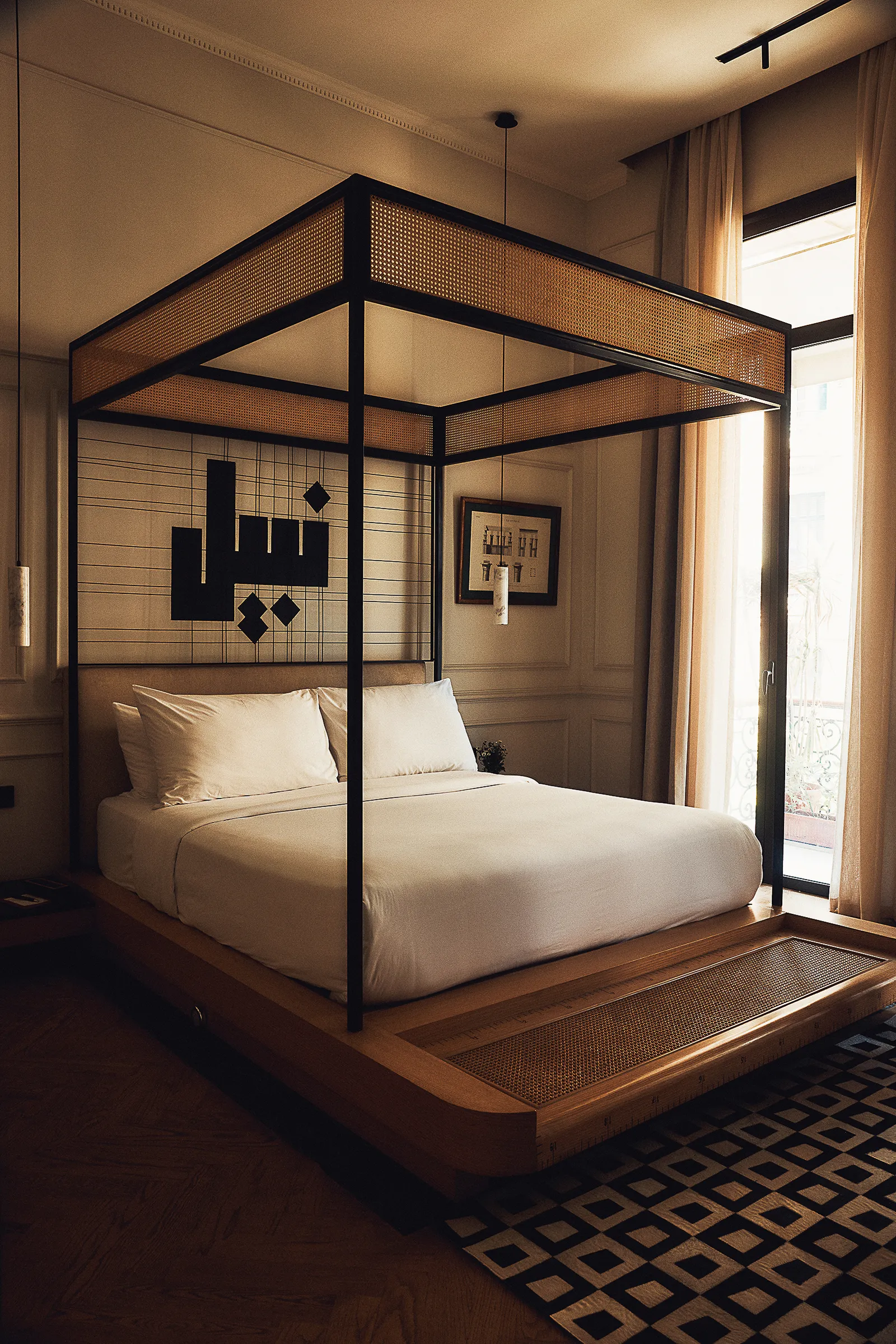
On a frenetic Cairo street where dented taxis vie for space with men on bicycles balancing trays of flatbread on their heads, a doorman in a red jacket and jaunty bow tie cuts a Wes Anderson-esque figure at the entrance to the recently opened Mazeej Balad hotel. Behind him, a burgundy carpet flows over a marble staircase like spilled wine, guiding guests into the 125-year-old building. The hotel’s interiors have been lovingly reimagined by young Egyptian designer Malak Orfy; in the lobby, a tree bursts from the bottle-green marble reception desk, light from a crystal chandelier reflects off the shiny chequerboard floor and a sleek cantilevered staircase lures guests up to the rooftop. Ceiling frescoes featuring Egyptian abstract artist Kairo Lumumba’s trademark squiggles lead to five individually designed rooms, and artworks by other local and regional artists – figurative sculptures by Sam Shendi, abstract portraits by Sabhan Adam, an embroidered canvas featuring dancing figures by Aliaa El Greedy – dot the rest of the hotel.
“From the start, we wanted the interiors to feel like a dialogue between past and present,” says Kareem Nabil, who, alongside business partner Ahmed Ganzoury, is behind the new opening. “The building already had so much to say. We just needed to listen.”
It’s a warm Tuesday evening in April and Mazeej Balad’s rooftop restaurant is packed with well-dressed Cairenes eager to experience the neighbourhood’s newest arrival. Nabil and Ganzoury welcome guests and pose for photos before we sit down for a dinner of koshary arancini and pickled lemon hummus. They are the force behind some of Egypt’s most glamorous events, as well as a handful of hotspots on the country’s North Coast, where the summer party scene is beginning to rival that of Mykonos. But with the bijou Mazeej Balad, they’ve turned their attention firmly to the capital.
I’ve been seduced by Cairo’s intoxicating energy since I first visited on a solo trip 10 years ago. An accident had left me with a months-long paralysis of my hand, and I was looking for a place that would get my blood racing and adrenaline pumping, that would be exciting and potentially challenging, and that would distract me from the pain and frustration of my injury. I found everything I was looking for in Cairo – in its crowded, dusty noisiness; its showstopping sights and insignificant backstreets; its heartbreakingly scruffy street cats and residents who broke into wide smiles whenever I made eye contact. I crossed the city on foot, from the medieval Citadel to Garden City on the banks of the Nile, from the leafy island of Zamalek to the busy bazaars of Khan El-Khalili. I took my life into my own hands every time I crossed a road, and jumped into battered old taxis whenever my legs got tired or my shopping bags got too heavy. I loved all of it.
A decade later, change is afoot. New satellite cities have sprung up, aiming to decentralise the capital and reduce congestion. They’re visible through the sand-filled air on the approach to Cairo International Airport, featuring Dubai-style residential compounds with pools and padel courts, relocated company headquarters and government ministries, sprawling malls with luxury boutiques and sleek coffee shops, and Ski Egypt, a 22,000-square-metre snow park with snowboarding lessons and resident penguins. The city’s longstanding crop of branded five-stars is being bolstered by new boutique hotels like Mazeej Balad.
Hidden within the Immobilia building, a pair of art deco towers that were once the tallest in the Middle East and Africa, are four renovated hotel apartments that form part of the Egypt Beyond collection, parent company of Al Moudira hotel and the Set Nefru dahabiya in Luxor. The building’s lobby, with its flickering LED lights and dusty corners, doesn’t inspire much confidence, but a ride in the ancient lifts leads me to thoughtfully appointed serviced residences with parquet floors, outdoor terraces elevated high above Cairo’s cacophonous streets, furniture and design pieces sourced from local antique dealers, and tablecloths, napkins and place mats embroidered by artisans from Threads of Hope, an organisation supporting underprivileged women.
Wherever you go in Cairo right now, the conversation inevitably turns to the long-anticipated – and long-delayed – Grand Egyptian Museum. It will officially open its full collection to the public later
this year, with all 5,000 pieces from the Tutankhamun collection on show for the first time, but GEM, as everyone here calls it, has been operating quietly for the past few months. When I visit, it’s a sleek, slick experience, with well-organised security checks, an online ticketing system and an exceptional tour by young, knowledgeable Egyptologist Ahmed Mokbil. The 11-metre-high, 83-tonne statue of Ramses II guarding the entrance to the halls has attracted plenty of social media attention, but I’m entranced by the tiny 5,000-year-old, ibis-shaped golden amulets honouring Thoth, said to be the divine inventor of writing, and the red-carpet-ready beaded dress-like shroud that would have covered the mummy of Hekaemsaf, overseer of the 26th dynasty’s royal fleet.
Huge picture windows frame the nearby Pyramids of Giza, but most visitors give them little more than a cursory glance as they hurry past on their way to the treasure- and light-filled galleries, where the artefacts have space to breathe, and so do visitors. Egypt may be one of the world’s most beguiling travel destinations, but visiting the country’s heritage sites can sometimes be a mix of mind-blowing ancient human achievement paired with harried guides and overzealous vendors. “The Grand Egyptian Museum is a real shift in how people experience Egypt,” Dr Ahmed Ghoneim, the museum’s CEO, assures me. “It’s completely reimagining what a museum visit can feel like, not just about looking at the past but connecting with it in new ways.”
After three exhilarating hours at GEM, I head back downtown. My taxi overtakes trucks packed with dangling meat carcasses and kamikaze scooters weaving in and out of the snarled traffic, the energy of the centre building to a crescendo the closer I get. A lot of the transformation of Downtown Cairo’s buildings, including Mazeej Balad’s home, can be credited to real estate company Al Ismaelia, founded in 2008 to protect and reimagine Downtown Cairo’s architectural heritage. Complex ownership structures, the need to adhere to preservation laws and to engage with diverse stakeholders mean it’s no easy task, but Al Ismaelia works closely with existing tenants, neighbours and small businesses in places like the 1930s-era Cinema Radio and the Tamara Building (named for a once-popular brand of cosmetics and shaving foam), now reborn as Tamara Haus. Architect Hourig Mekhtigian shows me around the restored neo-Renaissance building and, as we settle at Tchaï teahouse, sampling handmade chocolate flavoured with rose and ginger, she outlines how the floors above us will house a boutique hotel and rooftop restaurant, set to open next year.
The spaces are being brought to life by Alchemy Experience, the design studio founded by Egyptian architects Emy Hussein, Mohamed Fares and Hourig’s father, Karim Mekhtigian. On the ground floor is Analogue boutique, where copper tumblers and black earthenware bowls sit alongside earthy home fragrances rooted in traditional Egyptian craft and artistry, and Kyme, home to sculptural D’Hippo toys inspired by the ancient hippo goddess Taweret. On the first floor, concept store Objects by Marmonil presents furniture pieces by designers Tarek Shamma, Karim El Hayawan and Nehal Leheta that celebrate a long tradition of Egyptian marble craftsmanship; in the entrance is an installation of designer Omar Chakil’s Colorama Canopic jars, his personal reinterpretation of the containers used by Ancient Egyptians to store and preserve the internal organs of mummies in the afterlife, rendered by Chakil in alabaster onyx in shades of jade, teal and coral.
This contemporisation of Egypt’s craft legacy is evident across the city right now. Jewellery designer Azza Fahmy was a pioneer; her collections incorporate ancient motifs such as Nekhbet the vulture goddess, the Eye of Horus and geometric shapes found in the temples of Thebes, paired with one-off gemstones and precious metals. “You can’t preserve heritage without preserving craftsmanship,” says Fahmy’s daughter Amina Ghali, now the brand’s head designer. “For us, whenever we draw inspiration from Ancient Egypt, we do it with deep respect.” Sisters Aya and Mounaz Abdel Raouf’s bag designs for their brand Okhtein are inspired by everything from elegant North African soirées to the felucca boats that sail the Nile. Clutches made of brass mimic musical instruments, embellished with thousands of Swarovski crystals, and their bangle clutch echoes the gold bracelets that were symbols of status and protection for Ancient Egyptians.
In the Garden City neighbourhood on the banks of the Nile, the Cairopolitan studio and store is filled with souvenirs designed by Ahmed Hefnawy, a former advertising executive and prop-maker, with motifs from Egypt’s more recent history. Magnets feature retro corned beef cans, candles masquerade as iron weights, hand-tufted rugs are shaped like old cassettes and keyrings take the form of miniature butcher’s cleavers. Every item is made by traditional artisans, tasked with adapting their skills to Hefnawy’s pop-art designs. Across Cairo, there’s a growing sense that creativity and preservation can harmoniously coexist; that a modern sensitivity and reverence for history can be compatible, without slipping too far into gentrification. “It doesn’t need to be polished to be beautiful,” Nabil says of Downtown Cairo. “My hope is that we keep its grit and its charm, and just give it the love and attention it deserves.”
Mazeej Balad
The five stylish rooms at Mazeej Balad may be inspired by imaginary people – Abanoub the small-town explorer, Madame Marika the elegant hostess – but the comfort and warm welcome here are entirely real. The rooftop is already home to Downtown’s hottest new restaurant, frequented by Cairenes who dine on cherry kofta, molokheya and umm ali crème brûlée. Breakfast on the rooftop is a delight, with tameya, foul bean stew and baladi flatbread hot from the oven served as the city wakes to a crescendo of car horns.