By The New York Times Style Magazine MENA
Amid the bustling mix of shoe stores, clothing boutiques, street vendors, koshary stalls, shawarma joints, dessert patisseries, and traditional coffee shops lining Talaat Harb Street in Downtown Cairo, the striking Cinema Radio stands out, its bold vertical red letters on the façade glowing like a beacon. Inside, a glamorous crowd cheers and sings along as Egyptian performers take the stage at the newly opened cabaret-style Studio Samara.
“We’re not just reviving the golden era of entertainment and talent of Egypt; we also embrace what we have now, in the present,” says Kareem Nabil, CEO and founder of GnK Group, the events company behind Studio Samara. “It’s a very unapologetic showcase of our culture and entertainment, in a beautiful, historical venue.”
Cinema Radio had its heyday from the 1930s through 1960s, when it premiered major films during the golden age of Egyptian cinema and hosted legendary performances by Umm Kulthum. Built in 1932 by French and Armenian architects, it was modelled on New York’s Radio City Music Hall and featured Cairo’s largest theatre screen. Like many of Downtown’s iconic landmarks, however, it fell into disrepair after decades of neglect.
Transformation is on the horizon with a movement to breathe new life into the heart of the city, while safeguarding its architectural heritage through careful preservation. Cinema Radio is one of 25 buildings acquired by Al Ismaelia for Real Estate Investment, a company dedicated to honouring the district’s storied past and unlocking its contemporary potential. Since 2008, it has adopted a bottom-up approach, collaborating with partners to create mixed-use spaces aligned with current demand.
“We’ve focused on the arts and culture as a driver for the revitalisation of downtown. And I think this is where the popularity of downtown is coming from now,” says Karim Shafei, Al Ismaelia’s CEO and founder. “It offers something that is so distinct and so differentiated and so much more innovative and modern and edgy and dynamic than what you’re seeing in all those malls and gated communities.”
This contemporary revival echoes the bold ambitions that first shaped the city centre over a century ago. Khedive Ismail, who ruled Egypt from 1863 to 1879, had a vision to transform downtown into the ‘Paris of the East.’ Following European design principles, the district featured wide boulevards, grand squares and Belle Epoque architecture. It became home not only to ministries, banks, theatres, cinemas, cafés, and luxury department stores, but also to grand hotels, social clubs, embassies, elegant residences, and a cosmopolitan population.
After the 1952 revolution, Downtown’s character shifted as properties were nationalised, foreign residents and businesses departed, and maintenance declined. Strict rent control laws discouraged investment, trapping many buildings in a cycle of neglect. Although reforms in 1996 introduced market-based rents and opened the door to reinvestment, renewed upheaval – from the 2011 revolution centered on Tahrir Square to economic instability and the Covid pandemic – continued to present challenges.
Al Ismaelia’s first full refurbishment was the 130-year-old La Viennoise, built in Italian renaissance architectural style by an English architect. Renovated in 2016, it houses a couple of financial firms and Mazeej Balad, a boutique hotel with five unique suites and a popular rooftop restaurant that opened in January 2025.
Cinema Radio has been adding tenants since its restoration in 2015. Patrons hang out in the outdoor spaces at Sip specialty coffee, Diwan bookshop, and Italian eatery Jade. Upstairs, Almeria – which opened about a year ago – offers a sharing menu that spans the Mediterranean from Egypt to Syria, Greece, Spain and Morocco, as well as Armenia. Managing partners Reem and Mansour Abdulaziz, a sister-brother duo based between Vienna and Beirut, sought to create a culinary space that moves away from what they see as the fast, individualistic modern restaurant industry.
“This culture of ‘you eat yours and I’ll eat mine’ is basically becoming the opposite of what a restaurant should be,” says Reem Abdulaziz. “The traditional feel of a culinary space is being drowned out. Our response as Almeria is an antidote to that.”
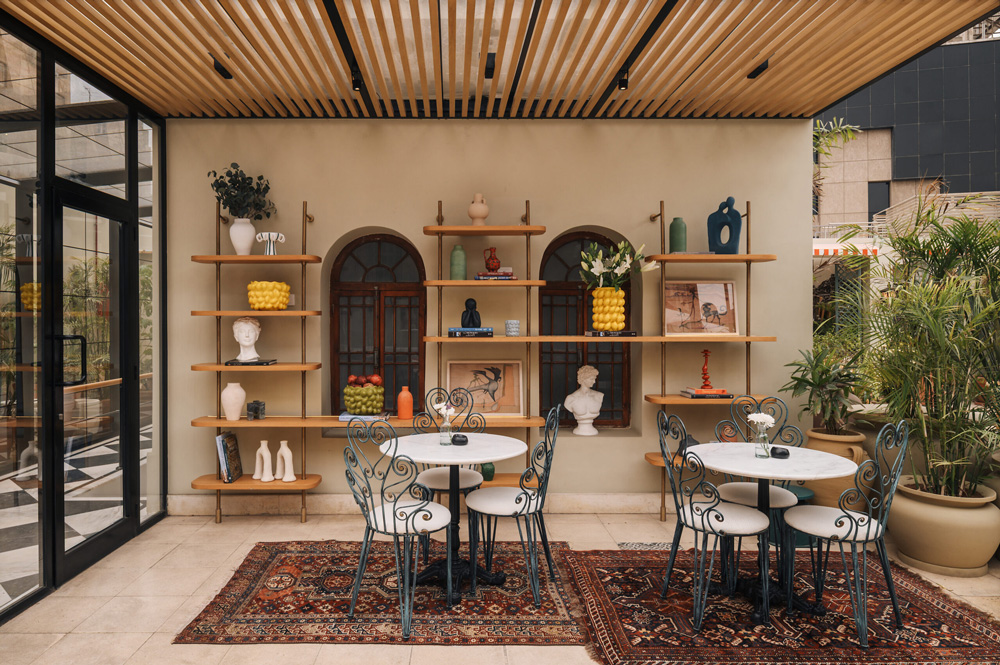
The restaurant has the feel of someone’s home and includes antiques from all over the Mediterranean region, such as vintage maps, a chandelier designed by a local Egyptian artisan, and a 1980s picture of Cinema Radio by renowned Lebanese photographer Fouad Khoury. The space mirrors downtown’s layered diversity, capturing a sense of place that feels both vibrant and suspended in time.
About a 10-minute walk away, TamaraHaus, built in 1910 in a neo-Renaissance style, was restored in 2022 and is operated by Alchemy Experience. It is the passion project of designer Karim Mekhtigian, who is of Armenian origin, but was born and raised in Downtown Cairo. After spending 15 years in Paris, he returned to Cairo and re-established his practice in the neighbourhood where it all began.
“I always say the plus in Egypt is this multi-layered culture that we have,” says Mekhtigian, who founded Alchemy design studio in 1998. “In Downtown, the architecture is a mix of Ottoman, Italian, Islamic, modern, Art Deco, Art Nouveau, but they work together. You don’t have this in other cities, this diversity.”
TamaraHaus includes a design showroom featuring local brands, an artisanal homeware store, and specialty teahouse Tchai. There are plans for a boutique hotel, a rooftop restaurant, an underground speakeasy and a department store.
Other dynamic spaces in Al Ismaelia’s portfolio include Consoleya, the former French Consulate reimagined as a co-working hub; The Factory, a former paper plant transformed into a creative and cultural venue; and the Kodak Building, which has served as a venue for art exhibitions and pop-up dinners. In recent years, an expanding calendar of events — from Cairo Design Week and Cairo Food Week to Cairo Photo Week, Art D’Egypte, and the Downtown Contemporary Arts Festival — has drawn crowds back to the area.
Youssef Shazli, the co-founder and director of independent film venue Zawya Cinema, has felt the evolution first-hand. When Zawya was first established in 2014, “there was a feeling that Downtown was a real cultural, artistic hub, but also very politically active,” he says. The excitement died down for a few years, before ramping back up again in recent months, bringing with it quiet questions about what might be lost as much as what is being gained.
“At the moment there is an interesting mix of things co-existing and very different social classes coming together in the same area, because the changes are quite rapid,” Shazli says. “It will be interesting to see in the next few years what will come out of this.”